
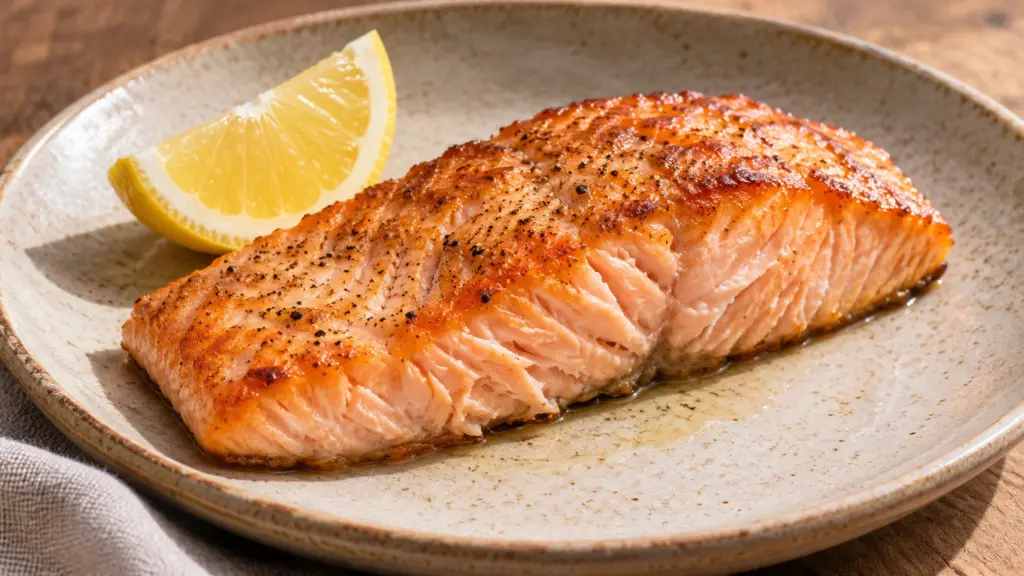
Salmon can look beautifully browned at the edges while the thick middle is still catching up. When dinner is nearly ready, the useful question is not whether the surface looks done—it is where you put the thermometer and what the center actually reads.
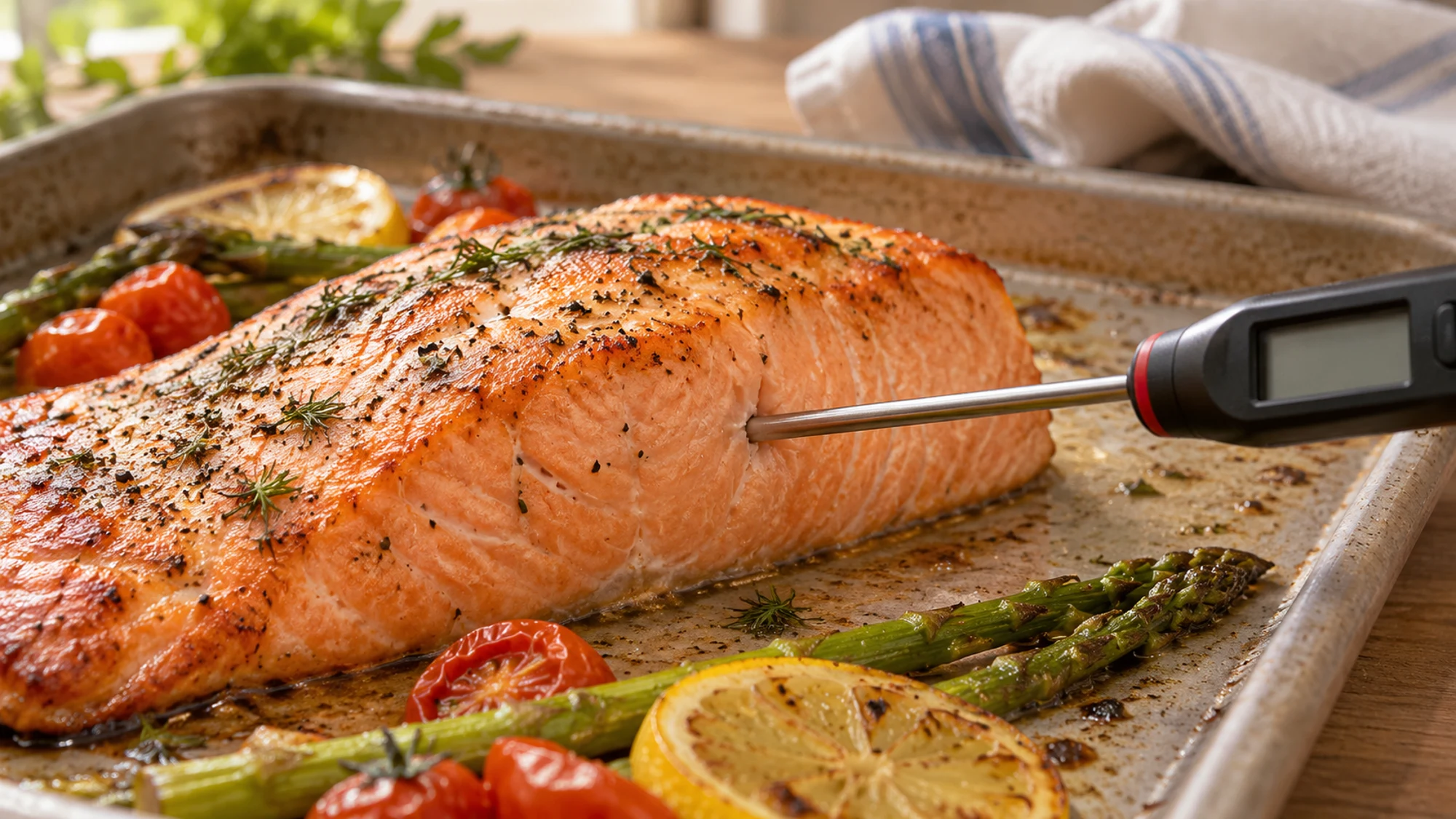
For ordinary home cooking, the recommended salmon internal temp is 145°F (63°C), measured in the thickest part. Check the center, avoid touching the pan, and do not treat a lower temperature chosen for texture as the same safety recommendation.
The Salmon Internal Temp to Aim For
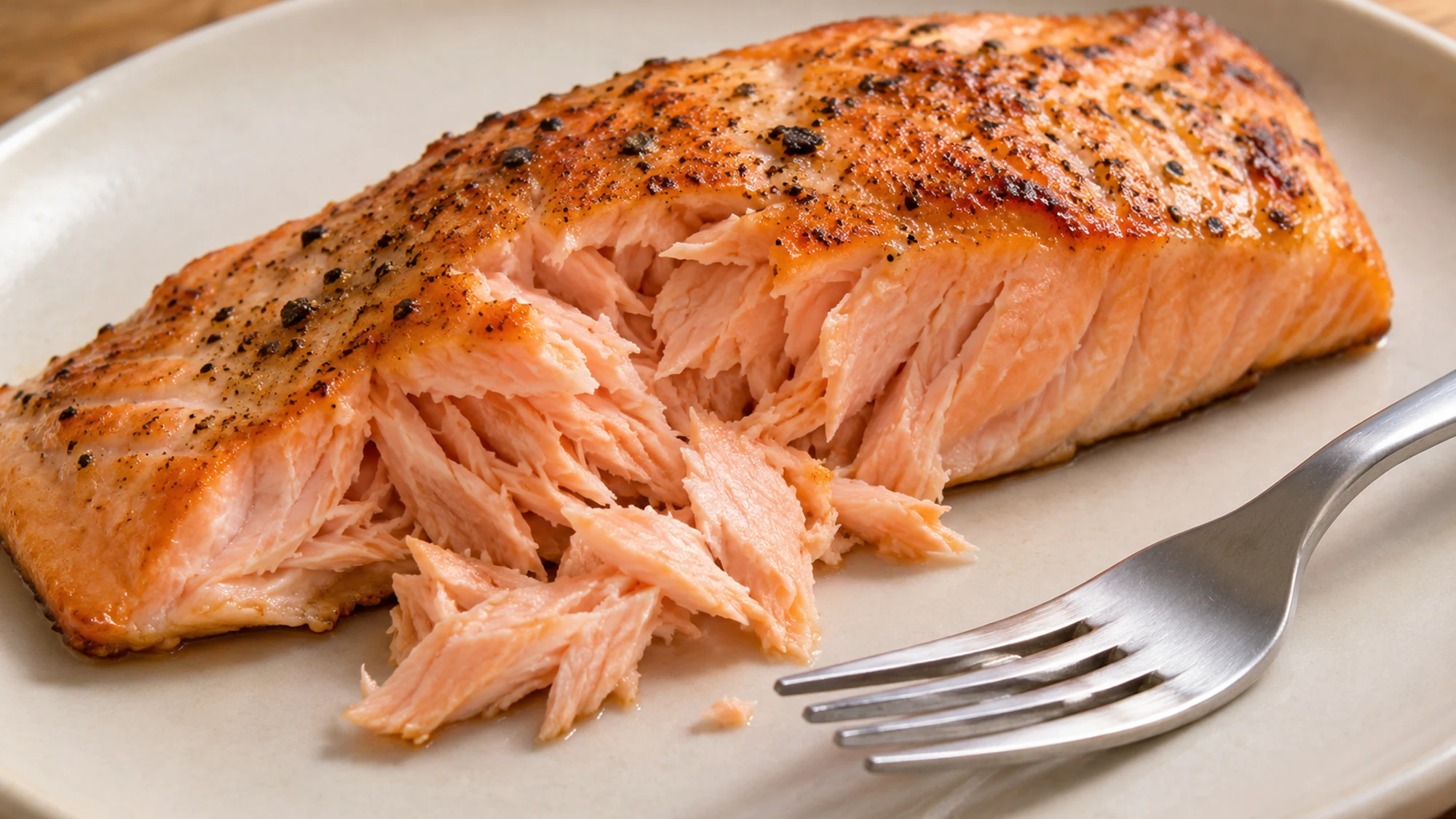
The FoodSafety.gov temperature chart lists 145°F (63°C) for fish, including salmon. It also describes flesh that is no longer translucent and separates easily with a fork; a thermometer gives you a direct measurement rather than asking you to judge safety from appearance alone.
Lower temperatures appear in recipes aimed at a softer, less-cooked center. Those are culinary preferences, not an interchangeable version of the standard recommendation. I would keep the safety target clear instead of calling every glossy-looking center perfectly cooked.
| What you are checking | Target or action | Why it matters |
|---|---|---|
| Freshly cooked salmon | 145°F (63°C) in the thickest center | Standard home-cooking endpoint for fish |
| Thin edges | Check the thick part too | An edge can finish before the middle |
| Cooked leftovers reheated hot | 165°F (74°C) | The leftovers recommendation differs from fresh fish |
| A recipe’s cooking time | Use it as a cue to start checking | Thickness and starting temperature vary |
Place the Probe Where the Answer Matters
A reading describes the spot where the thermometer’s sensing area sits. If the probe touches hot metal, passes through the fish or barely reaches past the surface, it cannot answer the question you meant to ask.
- Find the thickest section: Aim for its center, not a thin tail flap or browned corner.
- Try a side approach: For a thin fillet, inserting the probe horizontally can make it easier to keep the sensing area inside the flesh.
- Know your thermometer: Follow its directions for insertion depth and reading time. Different instruments do not sense temperature in exactly the same way.
- Check more than one place: A large side or uneven fillet may have several thicker areas. Multiple portions also need individual attention.
- Keep tools clean: Wash the probe as directed after contact with raw or undercooked fish, and use clean utensils for serving.
I’d rather make one careful center check than repeatedly poke the thin end. The goal is a trustworthy reading, not the biggest number you can find on the tray.
Why One Timer Cannot Fit Every Fillet
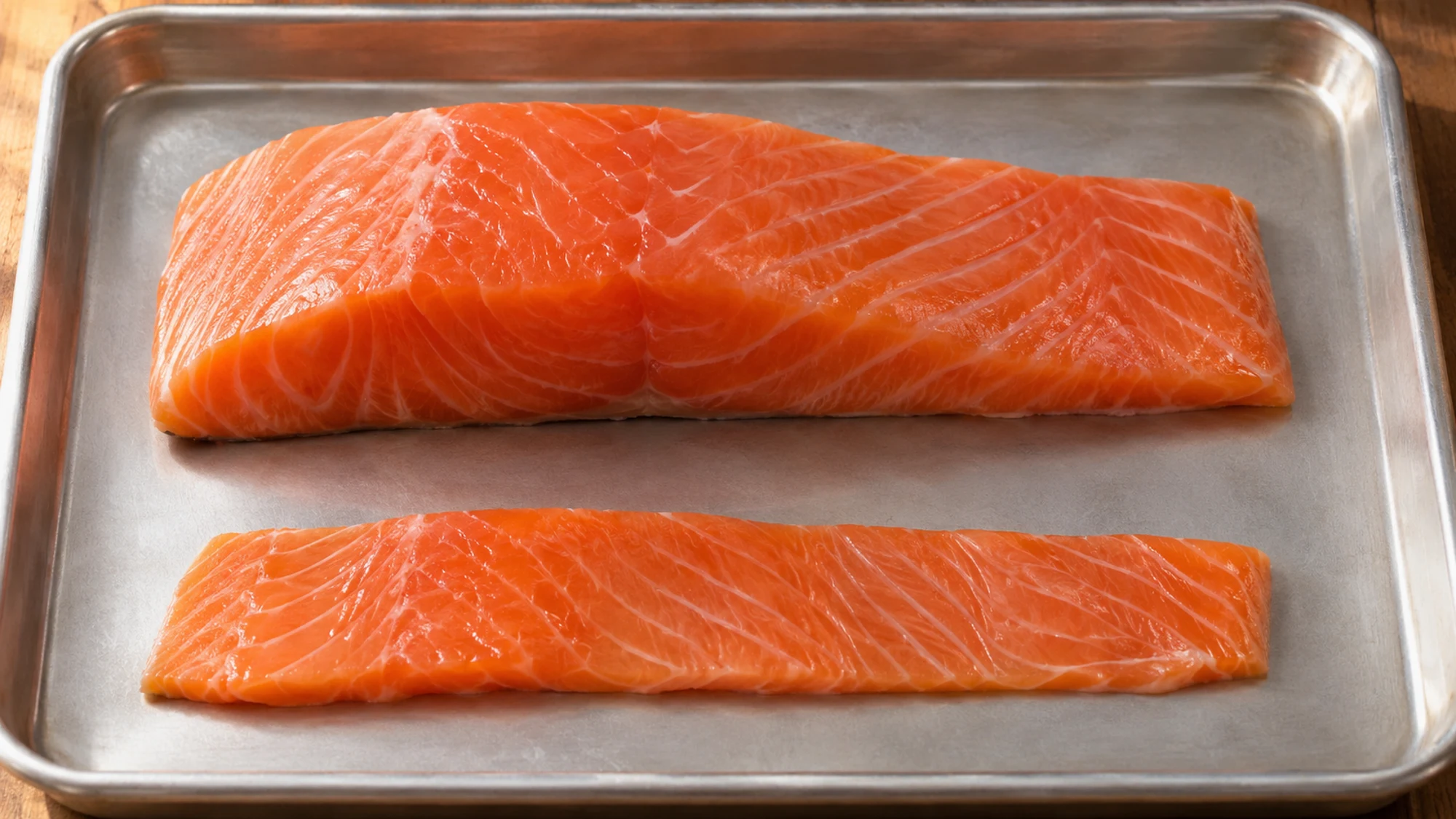
A thin tail piece and a thick center-cut portion do not cook at the same pace. Oven behavior, pan contact and whether the fish started fully thawed also affect the process; a timer is useful for remembering to look, not for proving the center is ready.
For a practical starting method, the lemon-dill oven-roasted salmon guide pairs moderate heat with center checks. Keep the method and the endpoint together rather than borrowing a short cooking time from a much thinner piece.
- Choose similar thicknesses: This makes a tray easier to manage, even when the portions have slightly different weights.
- Check before the estimate ends: Once the fish is close, short intervals are more useful than walking away for another long stretch.
- Do not promise fixed carryover: Temperature may rise after removal, but the change depends on the fish and cooking conditions. Do not assume it will reach a safe endpoint without measuring.
- Keep the rest of dinner ready: Extra time in a hot oven while a side dish finishes can turn a properly cooked fillet dry.
Tender salmon is easier to protect when the side dishes wait for the fish, not the other way around. Remove each portion when it reaches the proper endpoint.
Handle It Safely Before and After Cooking
A good final temperature does not replace careful storage and handling. FDA seafood guidance recommends refrigerator thawing, separation from ready-to-eat foods and prompt refrigeration after serving.
- Follow frozen-pack directions: Pay particular attention to instructions for vacuum-packed fish. Do not improvise countertop thawing.
- Separate raw and cooked: Use a clean plate for finished salmon and wash hands and food-contact surfaces after handling raw fish.
- Watch the room-temperature window: Refrigerate perishable seafood within two hours, or one hour when the temperature is above 90°F.
- Use extra care for higher-risk diners: Pregnant people, young children, older adults and people with weakened immune systems should avoid raw or undercooked seafood.
Color alone cannot resolve every doubt. Browning, seasonings and the natural color of the fish can distract from the center; use visual cues for texture and the thermometer for the temperature decision.
Bottom Line
Aim for a salmon internal temp of 145°F (63°C), check the thickest center accurately and stop cooking once the endpoint is reached. Good probe placement and timely checks do more for dinner than a rigid minute count.
The CDC video below explains the role of a food thermometer in checking cooked food. Its general principle applies here alongside the fish-specific temperature above.