
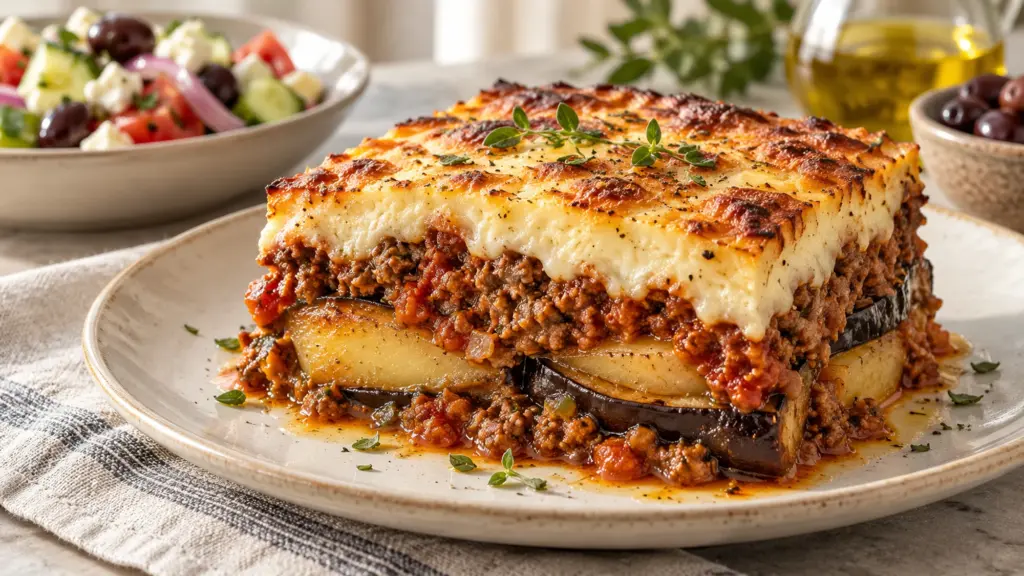
A clean slice of moussaka depends on what happens before the baking dish reaches the table. Watery meat sauce and firm vegetables make the layers slide around; roasted vegetables, a thick sauce and a short rest give the creamy topping something sturdy to sit on.
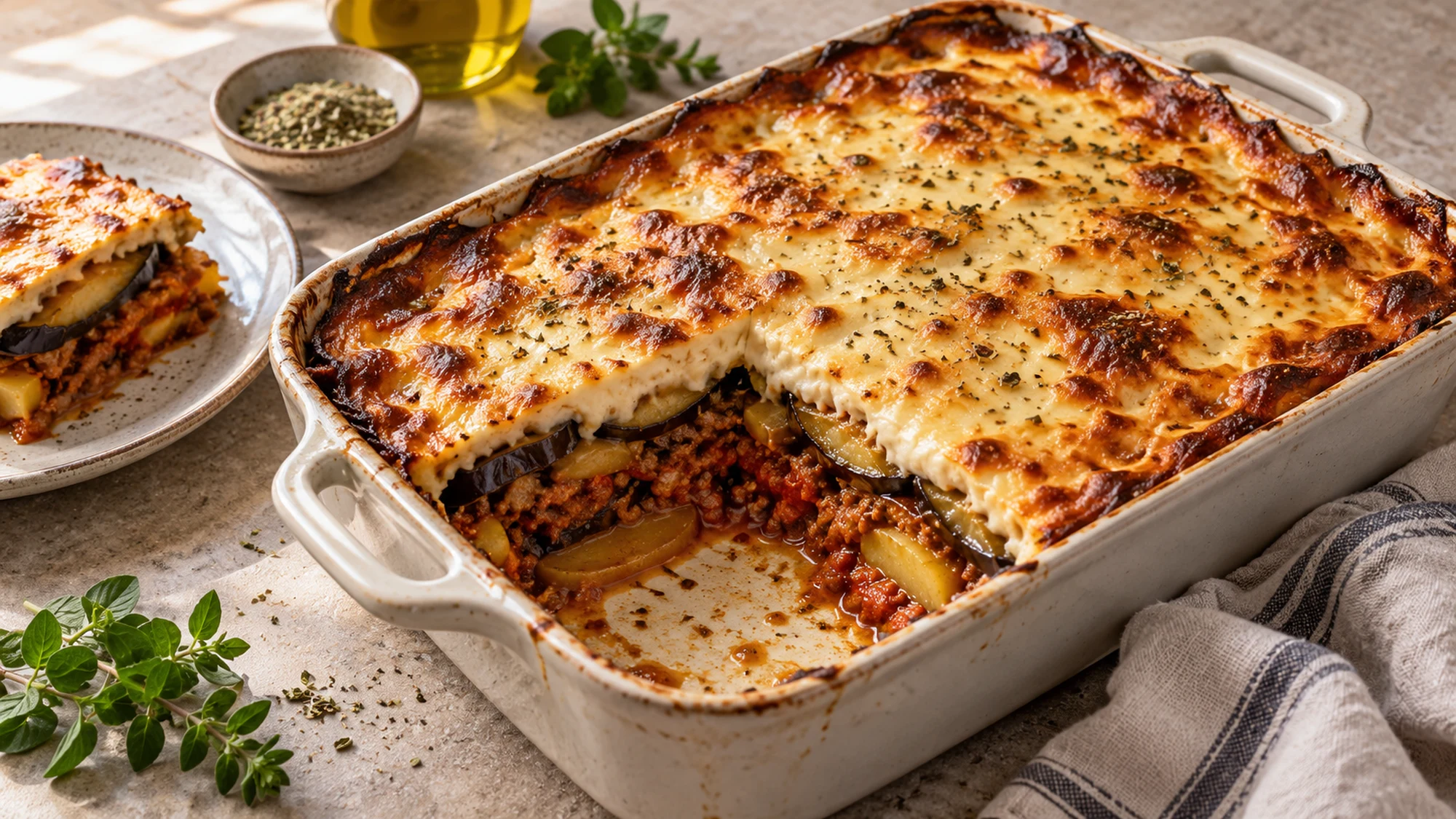
This moussaka layers roasted eggplant and potatoes with a cinnamon-scented beef sauce and béchamel. Cook each component until it has the right texture, bake until the center reaches 165°F, then rest the dish before slicing.
It is a weekend-style cooking project rather than a quick skillet dinner, but the work breaks into manageable parts. The vegetables roast while the sauce simmers, and the béchamel comes together in a saucepan. I’d clear a little counter space first; having somewhere to set the trays makes the whole process calmer.
Serving Suggestions for Moussaka
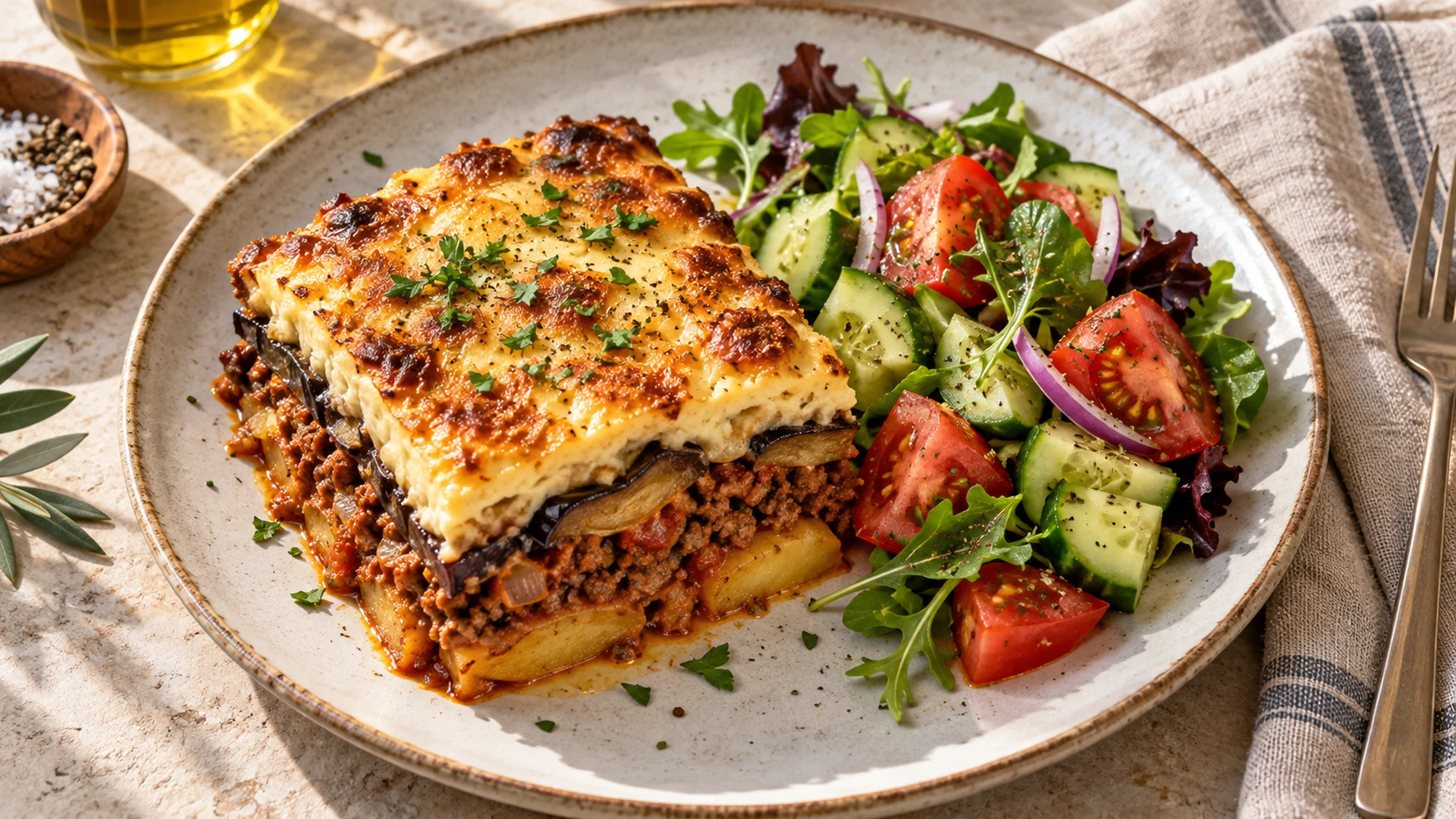
The dish already brings vegetables, potatoes, meat and a creamy sauce, so a crisp side is usually enough. Give it the full resting time before lifting out the first portion. The middle will still be hot, but the layers have a chance to settle instead of spreading immediately across the plate.
- Choose a fresh contrast: Cucumber, tomato and leafy greens with a light lemon dressing balance the richness without adding another heavy sauce.
- Keep portions practical: Cut the dish into eight servings. Start there, then adjust the rest of the plate to appetite rather than treating a photograph as a required portion size.
- Use a broad spatula: Slide it fully underneath the potatoes before lifting. A narrow spoon is fine for eating, but less helpful for carrying several soft layers.
- Plan the next meal: Chill extra portions promptly in shallow containers instead of leaving the entire casserole out until it reaches room temperature.
For an evening when you want an oven-based dinner with fewer separate components, baked feta pasta offers a different tomato-and-cheese direction. It is not a shortcut version of moussaka, just another useful option for a different amount of time.
A simple salad leaves room for the eggplant, warm spices and creamy top to stand out. This is one dinner that does not need a second rich casserole beside it.
Moussaka Variations and Texture Choices
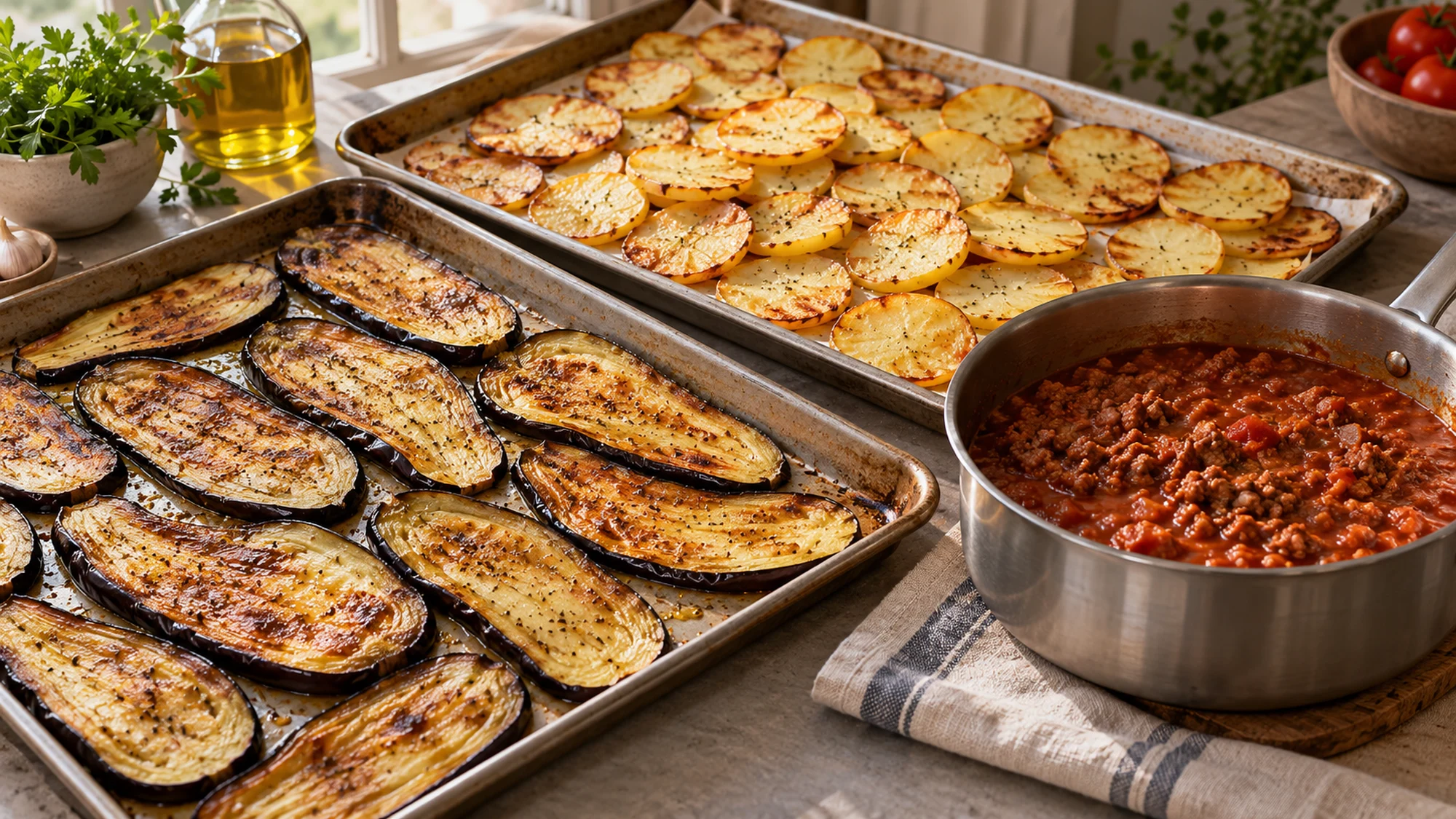
This version roasts the vegetables rather than frying them and leaves out zucchini. Other versions use different vegetables or meats, so there is no need to present this particular pan as the only way to make the dish. What matters here is keeping the components moist without letting them become watery.
I would resist adding more liquid to a thick-looking beef sauce just before assembly. The vegetables and topping contribute moisture too. If the eggplant slices are still firm, finish roasting them rather than expecting the final bake to solve every texture problem at once.
| Choice | Adjustment | What changes |
|---|---|---|
| Ground lamb | Replace beef by weight; drain excess fat | A more pronounced flavor and different nutrition |
| Less cinnamon | Reduce it to suit your taste | A quieter warm-spice note |
| Roasted vegetables | Keep slices in a single layer | Better browning than a crowded tray |
| Make-ahead portions | Chill after baking and reheat thoroughly | Firmer slices; the top may soften |
A thick sauce and tender roasted vegetables are the best preparation for tidy layers. Do not rush those stages merely because the top will look golden later.
Health Benefits and Sensible Trade-Offs
Eggplant and potatoes contribute fiber, beef supplies protein and milk adds calcium. Butter, cheese and the beef also contribute saturated fat, so the vegetables do not make the finished dish a light vegetable side. The recipe is a substantial main course with several ingredients doing different jobs.
- Check the center: Follow the FoodSafety.gov casserole guidance of 165°F (74°C). A browned surface alone does not show the temperature below it.
- Store safely: USDA leftover guidance recommends refrigeration within two hours, or one hour above 90°F (32°C), and using refrigerated leftovers within three to four days.
- Know the allergens: This béchamel contains milk, wheat and eggs. Replacing only one ingredient does not automatically make the whole dish suitable for an allergy.
- Read estimates as estimates: The card divides the entire dish into eight portions and counts all measured oil. Different beef, cheese and tomato brands change the result.
Enjoy the creamy topping as part of a complete meal, with a portion and side dish that suit you. Ingredient variety is useful; a sweeping health promise is not.
Bottom Line
Roast the vegetables until tender, simmer away excess liquid and give the finished moussaka twenty minutes to rest. Those practical pauses help each slice hold its eggplant, potato, beef and creamy topping together.
Moussaka Recipe

Ingredients
- 900 g eggplant About 2 large; cut lengthwise into 1/2-inch slices.
- 600 g potatoes Peeled, cut into 1/4-inch slices.
- 4 tablespoons olive oil 54 g, divided.
- 1/2 teaspoon fine salt 3 g
- 1/4 teaspoon black pepper
- 500 g 90% lean ground beef
- 1 medium onion 150 g, finely chopped.
- 2 cloves garlic 6 g, minced.
- 2 tablespoons tomato paste 32 g
- 400 g crushed tomatoes
- 1/2 cup water 120 ml
- 1 teaspoon dried oregano
- 1/2 teaspoon ground cinnamon
- 1/2 teaspoon fine salt 3 g
- 60 g unsalted butter
- 60 g all-purpose flour
- 3 cups whole milk 720 ml, warmed.
- 60 g finely grated Parmesan Divided.
- 2 large eggs Beaten.
- 1/4 teaspoon ground nutmeg
- 1/4 teaspoon fine salt 1.5 g
Equipment
- 9-by-13-inch baking dish At least 2½ inches deep.
- Two rimmed baking sheets
- Large skillet
- Saucepan and whisk
- Instant-read thermometer
Instructions
- Heat the oven to 425°F (220°C). Lightly oil a deep 9-by-13-inch baking dish. Spread eggplant and potato slices on separate rimmed baking sheets. Brush with 3 tablespoons of the oil and season with the vegetable-layer salt and pepper.
- Roast for 25–35 minutes, turning the slices and rotating the trays halfway through, until the potatoes are tender and the eggplant is softened with golden edges. Remove any pieces that finish early. Reduce the oven to 375°F (190°C).
- Meanwhile, heat the remaining tablespoon of oil in a large skillet over medium-high heat. Cook the onion for about 5 minutes. Add the beef and break it into small pieces; cook for 7–9 minutes, until browned and at least 160°F (71°C). Add the garlic and tomato paste and stir for 1 minute.
- Add the crushed tomatoes, water, oregano, cinnamon and beef-sauce salt. Simmer uncovered for 15–20 minutes, stirring, until thick enough that a spoon drawn across the pan leaves a brief clear trail. The sauce should be moist but not watery.
- For the béchamel, melt the butter in a saucepan over medium heat. Whisk in the flour and cook for 1–2 minutes without browning. Add warm milk gradually, whisking smooth after each addition. Simmer gently for 5–8 minutes, whisking, until the sauce thickly coats a spoon.
- Remove the sauce from the heat. Stir in 40 g of the Parmesan, nutmeg and béchamel salt. Let cool for 5 minutes. Whisk a few spoonfuls of the warm sauce into the beaten eggs, then whisk that mixture back into the saucepan off the heat.
- Arrange the potatoes in the baking dish. Layer with half the eggplant, half the beef sauce, the remaining eggplant and remaining beef sauce. Spread the béchamel across the top and sprinkle with the remaining 20 g Parmesan.
- Bake for 35–45 minutes, until the top is golden, the edges bubble and the center reaches 165°F (74°C). If it browns too quickly, tent loosely with foil. Rest for 20 minutes before cutting into eight portions.
- Refrigerate leftovers in shallow covered containers within 2 hours, or 1 hour above 90°F (32°C). Keep at 40°F (4°C) or below for 3–4 days. Reheat portions to 165°F (74°C).