
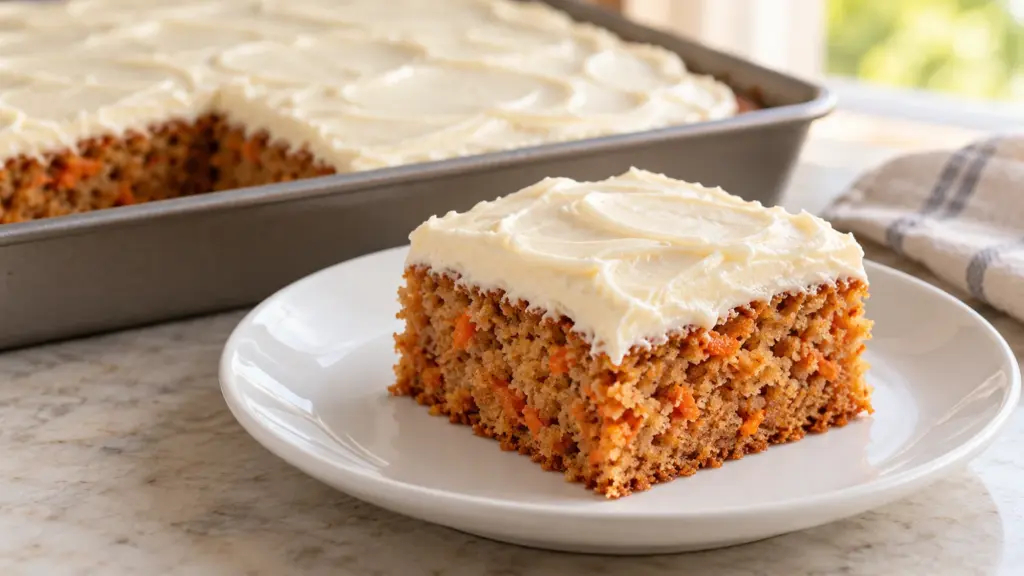
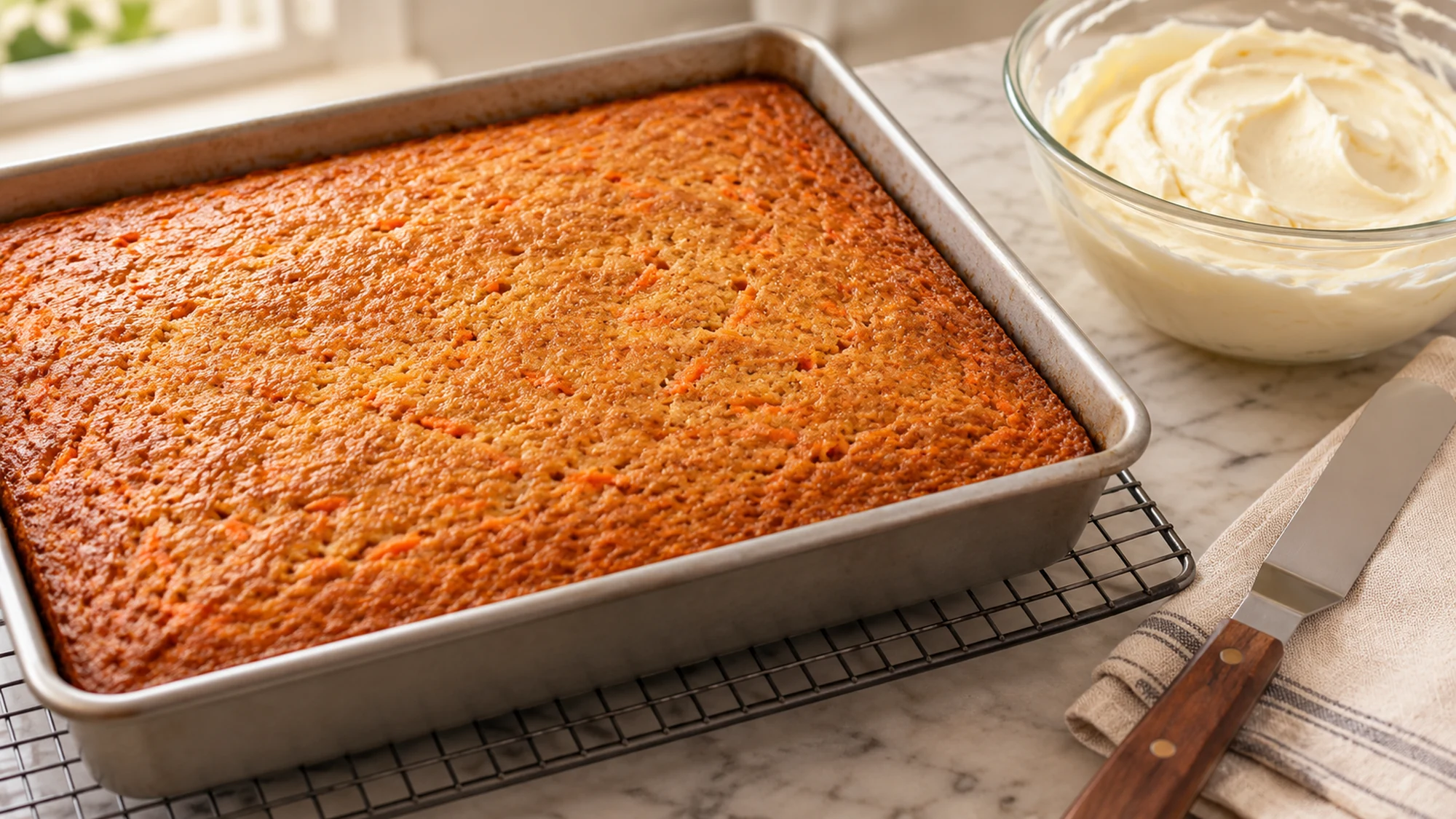
A carrot cake does not need stacked layers or a bag of decorations to feel generous. This version bakes in one rectangular pan, with finely grated carrots throughout the crumb and cream cheese frosting spread over the cooled surface. There are no nuts or raisins in the base recipe, so the carrot and cinnamon stay easy to notice.
Grate the carrots finely, mix the batter only until combined and let the cake cool completely before frosting. Cream cheese frosting belongs on a cool cake and the finished cake belongs in the refrigerator between servings.
I prefer a single layer when the aim is a relaxed dessert rather than a decorating project. You can cut tidy squares directly in the pan, and every serving gets the same balance of cake and frosting.
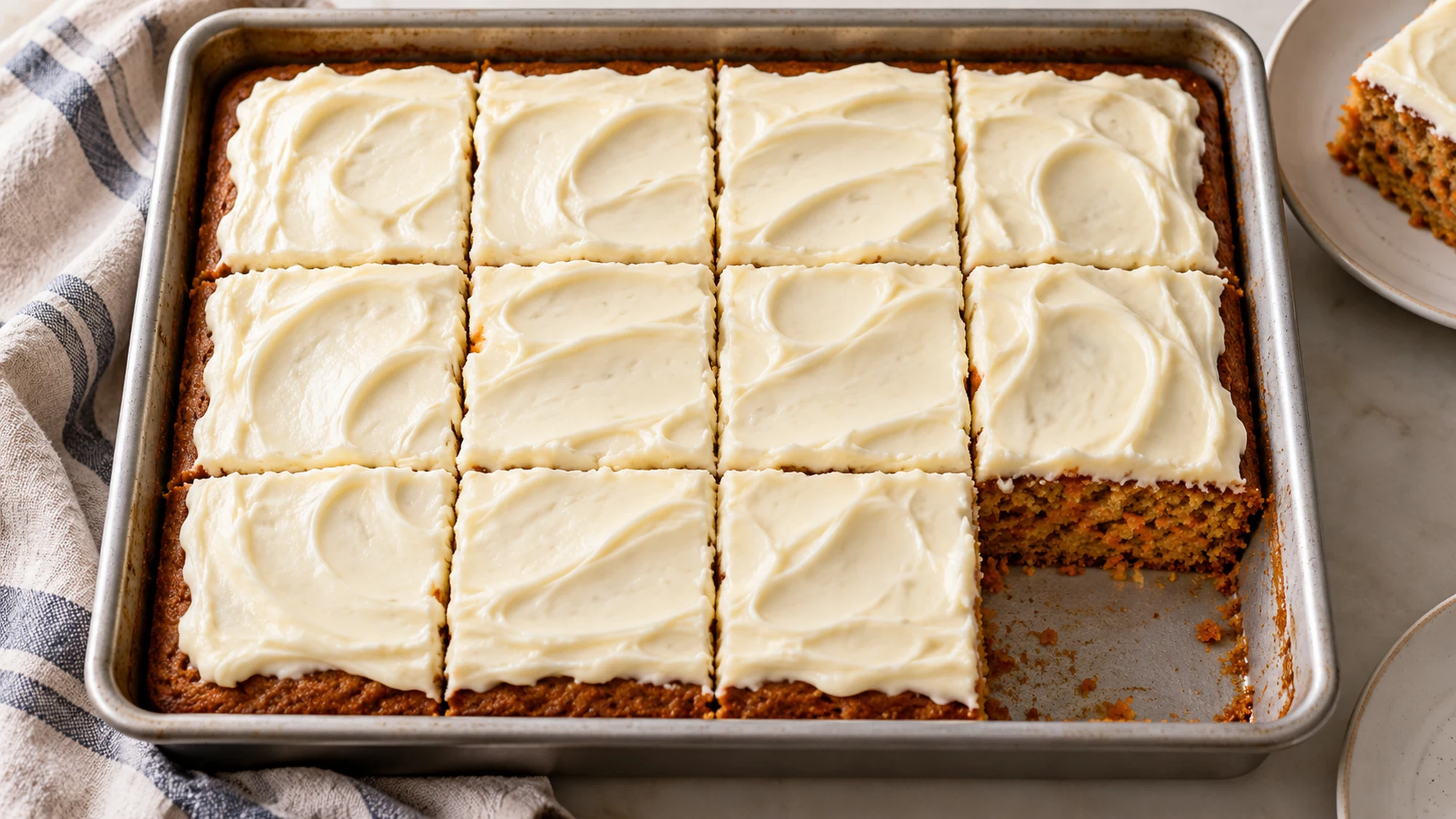
Serving Carrot Cake in Easy Squares
Cut the frosted cake with a clean knife, wiping it between slices when neat edges matter. Chilled frosting holds its shape more clearly than a soft layer, while the cake itself will feel firmer straight from the refrigerator. Bring out only the portions you intend to serve.
- Keep the plate uncluttered: A square needs little beyond a fork and perhaps an unsweetened drink. The frosting already provides a creamy contrast to the spiced crumb.
- For a gathering: Keep the remaining cake covered and refrigerated while serving a small plate of slices. I’d choose several fresh trips to the refrigerator over displaying the whole pan for hours.
A single-layer cake makes sharing straightforward. Keep the cuts simple, the serving utensil broad and the rest of the cake properly chilled.
Variations That Respect the Batter
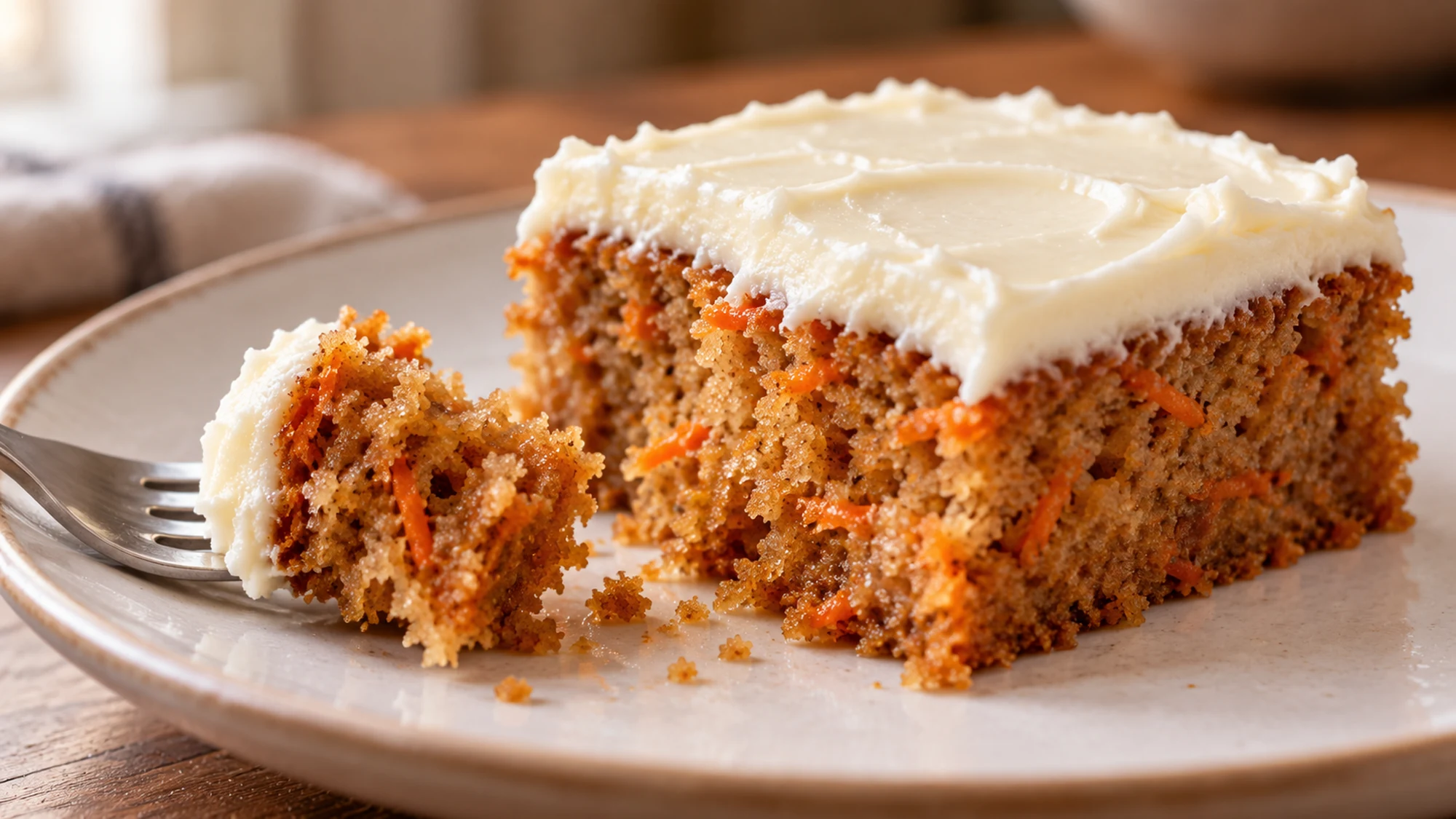
Freshly grated carrots behave differently from thick, dry-looking packaged shreds. Fine pieces distribute through the batter and are less likely to leave firm strands in a slice. Measure the prepared carrots by weight when possible; loosely filled cups can vary with the grater.
Plan changes around texture rather than decoration alone.
| Choice | Likely difference | Practical boundary |
|---|---|---|
| Finely grated carrots | More evenly distributed pieces | Do not puree them into liquid. |
| Coarse packaged shreds | More noticeable, sometimes firm strands | Fresh grating suits this cake better. |
| A deeper or smaller pan | A thicker center | Do not assume the same baking time. |
| Extra nuts or raisins | More texture and additional allergens | The base recipe is designed without them. |
- Weigh the flour: Too much flour can make the crumb heavier. If using cups, fluff the flour, spoon it into the measure and level the top instead of packing it down.
- Do not squeeze the carrots dry: Their natural moisture is part of the batter. Pat away excess washing water before grating, but do not wring out the prepared shreds.
- Check the center, not just the edges: A browned rim can appear before the middle is ready. Look for a center that springs back lightly and a tester without wet batter.
- Frost only after cooling: Warm cake can soften the butter and cream cheese into a sliding layer. If the frosting is too soft to spread neatly, chill it briefly rather than adding sugar without limit.
Small, deliberate choices protect the crumb. Changing the pan, carrot texture and added ingredients together makes it harder to know which adjustment affected the cake.
Health Benefits in Perspective
Carrots contribute vegetables and some fiber, but this is still a cake made with flour, sugar, oil and frosting. A slice is not nutritionally equivalent to a serving of raw carrots. The useful approach is to enjoy the dessert honestly and consider its portion alongside the rest of the meal.
- Check the full ingredient list: The cake contains wheat, eggs and milk ingredients. Leaving out nuts does not by itself establish that the finished cake is safe for someone with a nut allergy.
- Avoid raw batter: Both raw flour and eggs need proper cooking. The FDA’s flour-safety guidance applies even to a batter full of vegetables.
- Count the frosting: The nutrition estimate includes the measured cream cheese frosting. Leaving some frosting in the bowl or cutting different-size squares changes the amount actually eaten.
The carrots belong here for flavor, texture and moisture, not as a health claim. A satisfying dessert does not need a nutritional disguise.
Bottom Line
Carrot cake is easiest to manage when baking, cooling and serving each get their own time. Follow King Arthur’s cream-cheese cake storage guidance: keep the covered finished cake refrigerated and use it within three to four days. Do not store this frosting at room temperature.
Grate finely, stop mixing when the batter is combined and wait until the cake is cool to frost. The result is a straightforward sheet cake that can be shared one square at a time.
Carrot Cake Recipe

Ingredients
- 2 1/2 cups all-purpose flour 300 g, spooned and leveled
- 300 g finely grated carrots about 3 loosely packed cups
- 3/4 cup canola oil 160 g, plus a little for the pan
- 4 large eggs about 200 g without shells
- 1 cup granulated sugar 200 g
- 1/2 cup packed light brown sugar 100 g
- 2 teaspoons baking powder 8 g
- 1/2 teaspoon baking soda 2 g
- 2 teaspoons ground cinnamon 6 g
- 1/2 teaspoon fine salt 3 g
- 2 teaspoons vanilla extract 8 ml
- 8 oz block cream cheese 226 g, softened briefly for mixing; not spreadable tub style
- 1/4 cup unsalted butter 56 g, softened
- 1 1/2 cups powdered sugar 180 g, sifted if lumpy
- 1 teaspoon vanilla extract 4 ml
Equipment
- 9-by-13-inch baking pan 23 by 33 cm
- Grater
- Mixing bowls and whisk
- Hand mixer
- Spatula and cooling rack
Instructions
- Heat the oven to 350°F (175°C). Lightly grease a 9-by-13-inch baking pan. Wash and peel the carrots, then grate finely; do not squeeze the shreds dry.
- Whisk flour, baking powder, baking soda, cinnamon and salt in one bowl. In another, whisk oil, eggs, both sugars and vanilla until combined.
- Fold the dry ingredients into the wet just until no dry flour remains, then fold in the carrots. Spread evenly in the prepared pan.
- Bake for about 35–45 minutes, until the center springs back lightly and a tester inserted near the center comes out without wet batter. Begin checking at 35 minutes. Set the pan on a rack and cool completely, about 2 hours, before frosting.
- For the frosting, beat cream cheese and butter together until smooth. Beat in the powdered sugar gradually, then the vanilla, just until smooth and spreadable. If too soft, chill briefly; do not keep beating a warm mixture.
- Spread the frosting over the completely cooled cake. Cover and refrigerate. Cut into 16 squares with a clean knife, and bring out only the portions you plan to serve.